
The Seller Confidence Score: How Brokers Make Sure Every Listing Is Actually Being Marketed
If you run a brokerage or oversee a team of agents, you already know the quiet risk that lives inside every active listing: a seller who feels like nothing is happening. The home is listed, the sign is in the yard — but the marketing went dark, and the seller is sitting at home wondering whether they hired the right agent.
You can't watch every agent's Instagram. You can't manually audit whether each listing got its Just Listed post, its open-house promotion, and its weekly features. So how do you actually know, across your entire office, that every seller is being marketed to — and that every seller is happy?
That's the problem the Seller Confidence Score in LaunchListing was built to solve. It gives brokers, COOs, and marketing managers a single number — per listing and across the whole brokerage — that answers one question at a glance: are our sellers getting the marketing they were promised?
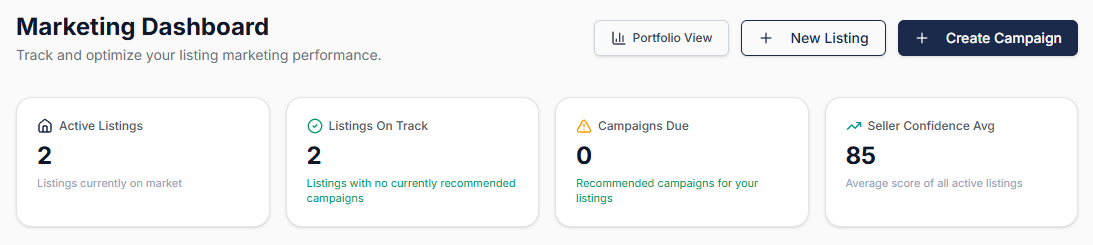
The Marketing Dashboard KPI row — one glance shows active listings, campaigns due, and the brokerage-wide Seller Confidence Avg.
What Is the Seller Confidence Score?
The Seller Confidence Score is a 0–100 rating LaunchListing calculates for every active listing. It measures how consistently and effectively that listing is being marketed — the way a seller would experience it. A high score means the seller is seeing steady, visible activity. A low score means the listing has gone quiet, and the seller is likely starting to wonder why.
At the top of the Marketing Dashboard, those individual scores roll up into a single brokerage-wide KPI: Seller Confidence Avg. It's the average of every active listing's score, and it's the number a broker or marketing manager can glance at each morning to take the temperature of the entire office.
How Powell Real Estate uses it: Broker Bryan Powell monitors the Seller Confidence Avg across all of Powell Real Estate's listings and holds the office to a standard of 85 or above out of 100, striving for 90. If the average dips, it's an early signal that a listing — and a seller relationship — needs attention before it becomes a phone call.
How Is the Seller Confidence Score Calculated?
The score isn't a vanity metric or a guess. It blends four real signals of marketing health, each weighted by how much it actually affects a seller's experience:
In plain terms: doing the right marketing steps, on time, consistently, and getting them seen is what drives the score up. The heaviest weight sits on completion and recency — because those are exactly the two things a seller notices first when they stop happening.
What Do the Scores Mean? The Four Tiers
Every listing is bucketed into one of four momentum tiers, color-coded so a manager can scan a portfolio in seconds:

The Listing Performance Overview — each listing's Seller Confidence score sits right next to its agent, status, reach, and last campaign, so a manager can spot the one that's slipping in seconds.
What Makes the Score Go Up or Down?
Because the score is built from real marketing behavior, it moves for reasons you can act on. Here's what drives it in each direction:
What raises the score
- Completing each recommended campaign step on time — Just Listed, Open House, feature posts, and the weekly promotions LaunchListing schedules for every listing.
- Posting consistently — never letting a listing sit untouched for more than a week.
- Building volume — a steady stream of posts over the listing's life, not one burst at launch.
- Earning reach — content that actually gets in front of buyers and the seller's sphere.
What drags the score down
- Skipped or missed steps — a recommended campaign stage that came and went without a post.
- Going dark — long gaps since the last post are the single fastest way to tank a score.
- Thin volume — only a post or two for the entire listing.
- Low reach — marketing that technically went out but isn't being seen.
You can see all of this on a single listing's marketing checklist. Every recommended step is marked Completed or flagged as a Missed Opportunity, the confidence ring shows the current score and tier, and LaunchListing surfaces the next move to make:
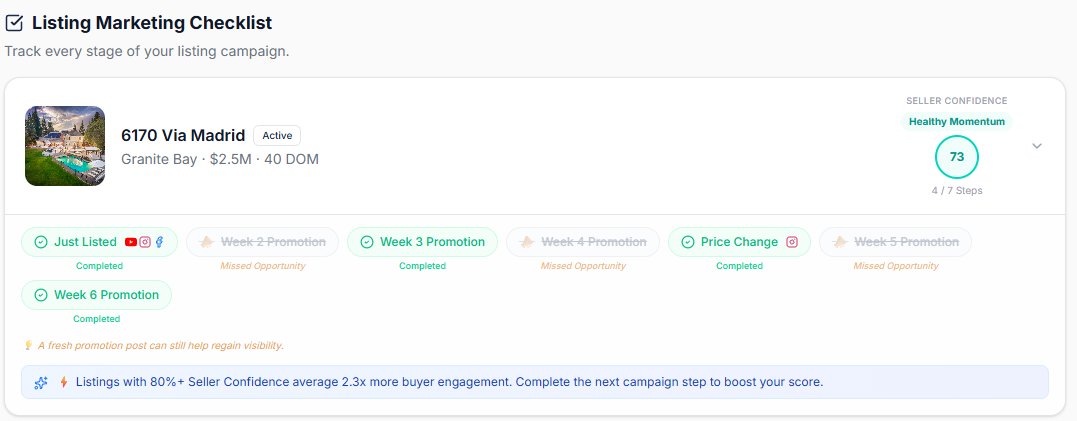
A single listing's marketing checklist — completed steps, missed opportunities, the current score and tier, and the next recommended move, all in one view.
The payoff is real engagement: Inside LaunchListing, listings that hold an 80%+ Seller Confidence score average 2.3× more buyer engagement. Keeping the score high isn't busywork — it directly correlates with more eyes on your sellers' homes.
Why this matters for oversight: A falling Seller Confidence Score is a leading indicator, not a lagging one. It tells you a listing is slipping before the seller notices — which is exactly the window a broker or marketing manager wants to coach the agent and get the campaign back on track.
How Does a High or Low Score Impact the Seller?
This is the part that matters most, because the score is ultimately a proxy for the seller's experience.
When a listing has a high Seller Confidence Score, the seller is watching their home get marketed in real time. They see the posts, they get tagged, they forward them to friends, and they feel like they made the right choice in hiring you. Confident sellers are patient sellers — they're less likely to complain about days on market, less likely to push back on price conversations, and far more likely to refer you to the next person on their street.
When a listing has a low score, the opposite happens. Silence breeds doubt. The seller fills the vacuum with worry: "Is my agent even working on this?" That's the seller who calls the office, asks to speak to the broker, or quietly decides not to renew the listing. By the time that call comes, the damage is already done — which is why catching a low score early is worth so much more than explaining one after the fact.
Why Brokers, COOs, and Marketing Managers Rely on It
If you provide oversight over a team of agents, the Seller Confidence Score turns an impossible manual task — auditing every listing's marketing — into a single dashboard glance:
- One number for the whole brokerage. The Seller Confidence Avg tells you, every morning, whether your office is delivering on its marketing promise.
- Instant accountability. Per-listing scores show exactly which properties — and which agents — are slipping, so coaching is targeted instead of generic.
- Fewer seller escalations. Catching a "Needs Attention" listing early means fixing it before it becomes a complaint that lands on your desk.
- A standard you can manage to. Setting a target like Powell's — 85 or above, striving for 90 — gives your whole team a shared, visible bar for what "good marketing" looks like.
- Proof of your brokerage's value. Robust, consistent marketing — and the reports that show it — is what wins listings and keeps sellers loyal.
Frequently Asked Questions
What is the Seller Confidence Score in LaunchListing?
It's a 0–100 score LaunchListing calculates for every active listing that measures how consistently and effectively the listing is being marketed — the way a seller experiences it. A high score means steady, visible marketing activity; a low score means the listing has gone quiet. The individual scores roll up into a brokerage-wide "Seller Confidence Avg" KPI on the Marketing Dashboard.
How is the Seller Confidence Score calculated?
It blends four weighted signals of marketing health: Campaign Completion (40%) — whether the listing's recommended marketing steps have been posted versus skipped; Recency (30%) — how recently the listing was last posted about; Volume (15%) — the total number of posts published; and Engagement (15%) — the total reach those posts earned. Completing the right steps, on time, consistently, and getting them seen is what drives the score up.
What is a good Seller Confidence Average for a brokerage?
LaunchListing buckets listings into tiers: 85+ is Strong Momentum, 70–84 is Healthy Momentum, 55–69 is Building Momentum, and below 55 is Needs Attention. Many brokers set an office-wide standard of 85 or above — the bar Powell Real Estate broker Bryan Powell holds his team to, striving for 90 — to ensure every seller is consistently marketed. Inside LaunchListing, listings that hold an 80%+ score average 2.3× more buyer engagement.
How does the Seller Confidence Score help brokers and marketing managers oversee agents?
It replaces manual marketing audits with a single dashboard view. The brokerage-wide average shows whether the office is delivering on its marketing promise, while per-listing scores pinpoint exactly which properties and agents are slipping. Because a falling score is a leading indicator, brokers can coach an agent and fix a campaign before the seller ever notices a problem.
How does a low Seller Confidence Score affect the seller?
A low score usually means the listing has gone dark — no recent posts, missed campaign steps, low reach. From the seller's seat, silence breeds doubt about whether their agent is working. That's the seller who calls the broker, pushes back on price, or declines to renew the listing. A high score does the opposite: it keeps sellers confident, patient, and far more likely to refer.
What makes the Seller Confidence Score go up or down?
It goes up when agents complete each recommended campaign step on time, post consistently, build steady post volume, and earn real reach. It goes down when steps are skipped or missed, when a listing goes more than a week or two without a post, when post volume is thin, or when content isn't being seen.
Give every seller a reason to stay confident — and give yourself one number to prove it.